Most people who get turned around at the Swiss border did everything on the list. They just did it in the wrong order.
That's the thing nobody tells you. Swiss pet entry isn't a checklist where the items are independent — several of them only count if they happened in the right sequence, and one has a three-week clock attached. Get the sequence wrong and you don't get a warning; you get a rejected animal at a border veterinary office, at your expense.
The order of operations is the whole game
Your animal needs three things to enter Switzerland from the EU: a microchip, a valid rabies vaccination, and an official pet passport.
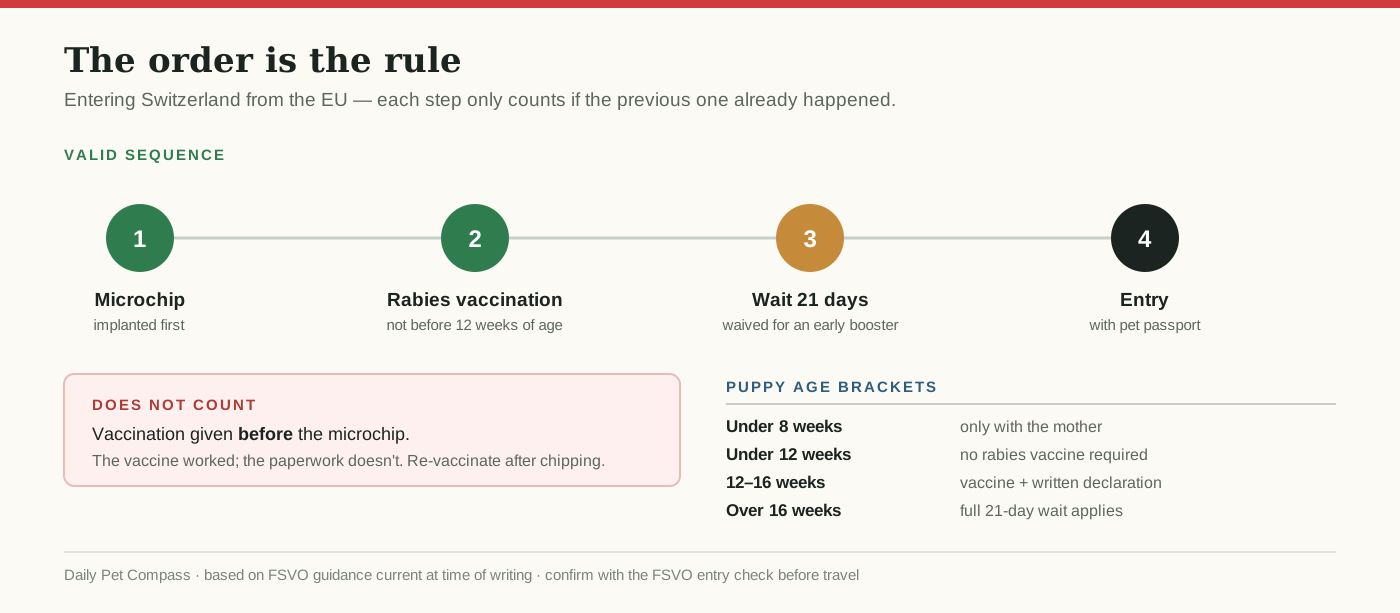
Read this part twice: the microchip must be implanted before the rabies vaccination. Not the same day, not shortly after — before. A vaccination given to an unchipped animal doesn't count for entry purposes, even though the vaccine itself worked perfectly well. If your vet did it the other way round, the fix is to re-vaccinate after chipping and start the clock again.
Then the clock. For an animal over 16 weeks, entry is only permitted once 21 days have elapsed since the rabies vaccination. There's one useful exception: if you're getting a booster before the previous one expires, the waiting period doesn't apply. Worth planning around — keeping boosters current means you can travel on short notice, while letting one lapse locks you out for three weeks.
Your Swiss passport is still valid
The EU updated its pet travel legislation in May 2026, which caused a round of panic in expat groups. The Swiss position is straightforward: the Swiss pet passport remains valid and is treated as equivalent to the EU pet passport. Both are recognised in both directions.
Veterinary health certificates are a separate matter — those are only needed when entering the EU or Switzerland from a third country, not for movement between Switzerland and the EU.
So if someone tells you your Swiss passport has been invalidated, they're wrong.
Puppies, by age bracket
This is where it gets genuinely fiddly, because the rules change twice within a month of the animal's life.
Under 12 weeks: passport and microchip required, but no rabies vaccination needed to enter. Puppies up to eight weeks old may only enter accompanied by their mother.
12 to 16 weeks: passport, microchip (before the vaccine), and a rabies vaccination — which can't be given before 12 weeks of age. The 21-day wait can be waived here with a written declaration that the animal has had no contact with wild animals susceptible to rabies since birth. If the puppy is travelling with its still-nursing mother, that confirmation isn't required.
Over 16 weeks: passport, microchip, rabies vaccine, full 21-day wait.
One historical quirk if you're importing an older rescue: a tattoo can substitute for a microchip, but only if you can prove it was done before 3 July 2011. After that date, chip or nothing.
Coming from outside the EU? You cannot drive in
This is the rule that surprises people most, and it's absolute: entry from a third country is only permitted through authorised points of entry, meaning direct air transport via Basel, Geneva, or Zurich airports. There is no compliant way to land your animal in a neighbouring country and drive it across.
On arrival you present the animal at the red customs exit. If the paperwork is incomplete or conditions aren't met, the animal goes to the border veterinary office in the airport freight area — and if you've arrived outside that office's working hours, it goes to their animal facility until the next working day. You pay for the transport and the stay.
Requirements are stricter again from a country with rabies risk: blood titre testing, longer waiting periods, an import licence. The authorities publish a country list categorised by rabies risk, and it gets updated — check the current version, not a blog's summary of it.
Two things that get you refused regardless of paperwork
Docked ears or tails. It is forbidden to bring dogs with docked ears and/or docked tails into Switzerland. This catches people importing from countries where the practice is still legal, and a perfect vaccination record doesn't rescue it.
More than five animals. A maximum of five dogs, cats or ferrets per private vehicle moves under the pet rules. Above that you're in commercial-import territory: cantonal veterinary authorities, a TRACES certificate, a different process entirely. There's a carve-out for competitions and exhibitions — more than five is allowed with written proof, provided the animals are at least six months old.
There's also a sensible provision if you can't fly with your animal: an authorised person may transport it, but the owner must travel within five days before or after, with a written declaration attached to the passport.
After you land, a second clock starts
Switzerland requires every dog to be registered in a central national database — AMICUS. If you've imported the dog, the deadline is tight: an imported dog must be registered by a veterinarian within 10 days of entry. Not "sometime that month." Ten days.
There's a split here worth getting right the first time. The vet registers the animal. Your commune manages your personal data. So if you move or your details change, you tell the Gemeinde — but if the dog is rehomed, taken over by someone else, or dies, that goes directly to AMICUS. People routinely update one and not the other, then discover the mismatch at the worst possible moment.
Then there's dog tax, which is cantonal and communal rather than federal, so the amount and the deadline depend on where you live. Look up your own commune's rules — this is one of many areas where "Switzerland requires X" is the wrong frame and "my commune requires X" is the right one.
The practical version
Six weeks before you move: chip first, vaccinate second, get the passport, count 21 days forward, and check whether you're flying from a rabies-risk country. If any of those four things is out of order, fix the order rather than hoping.
And check the federal entry-check tool before you book anything. These rules changed in 2026 and they'll change again — anything you read on a blog, including this page, is a map rather than the territory.