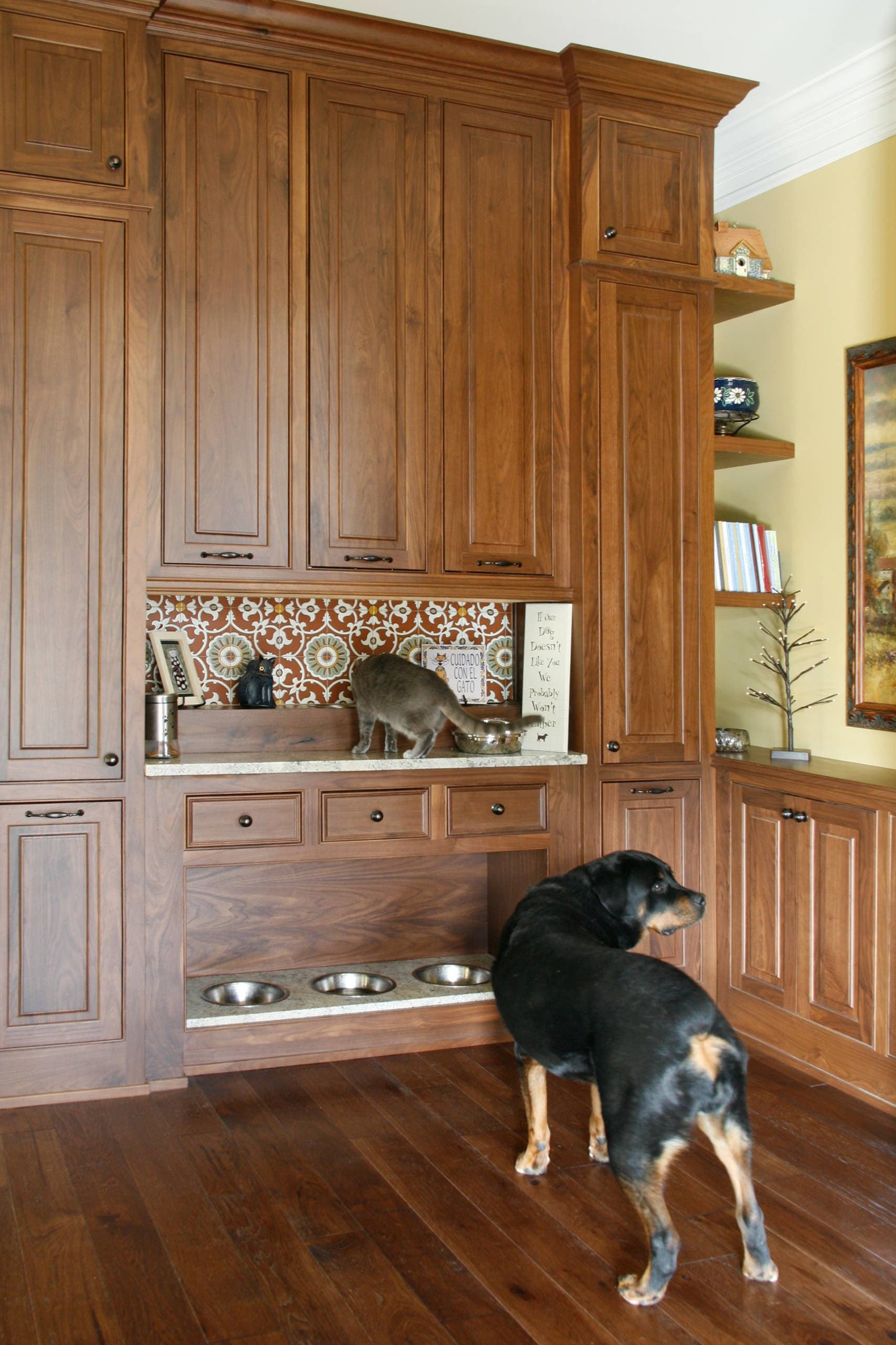
Search for a pet feeding station and you will be sold a tray. Usually with matching ceramic jars, a chalkboard label, and a raised wooden frame.
The tray is the least important object in this article. The most important one is the bag the food came in, which most of those setups are specifically designed to throw away.
The bag is the part you keep
Decanting kibble into an attractive airtight jar is the single most-recommended and least defensible step in pet-food storage.
The original packaging carries the lot code, the best-before date, the ingredient panel, and the manufacturer's feeding directions. If your animal reacts badly to something, or a recall is announced two months from now, the lot code is the only thing connecting the bag in your kitchen to the batch in the notice. A jar of anonymous brown pellets tells a vet nothing and tells the manufacturer less.
The FDA's own guidance on handling pet food is to keep food in its original packaging where possible — and if you want the aesthetic, the answer is trivially easy: put the closed bag inside the bin. You get the seal, the container, and the paperwork.
Store it somewhere cool and dry, and do not keep topping up an old layer. When a bag is finished, wash and dry the outer bin before the next one goes in, because the fat that has been coating the inside of it for six weeks goes rancid.
Watch one meal before you move anything
Do not rearrange the kitchen yet. Stand back and watch a single ordinary meal, and answer four questions.
Does the bowl slide? Does water reach the wall or the skirting? Does a second animal drift over and hover? Does the animal pick food up and carry it somewhere else to eat it?
Each of those points at a different problem — traction, splash containment, social pressure, or a feeling of exposure — and each has a different fix. Guessing between them is how people end up owning four bowls.
Choose a spot where the animal can eat without being cornered by a person, another pet, or an appliance that starts up mid-meal. Away from the litter box, away from cleaning chemicals, and not in a doorway or a walkway. Close to a sink is a genuine convenience, because the station that gets cleaned is the one that does not require a journey.
What the surface actually has to do
Two things: survive being wiped every day, and let you see what is on it.
A sound, wipeable floor or a flat washable mat does the whole job. A raised lip helps with water and with enthusiastic wet-food eaters, and a deep textured mat is worse than bare floor, because it traps residue in the pattern and hides it until it smells.
Whatever goes under the bowls has to come up. If you cannot lift it and see the floor beneath in under three seconds, moisture will sit under there for weeks.
The scoop rule almost everyone breaks
Use a dedicated measure, stored clean and dry — and specifically, do not use the animal's bowl as the scoop.
That is explicit FDA guidance and it is broken in most households, because dipping the bowl into the bag is the obvious thing to do. It moves saliva and food residue directly into the storage container, where it sits at room temperature until the bag is finished. The FDA's accompanying instruction is to wash bowls and measuring utensils with soap and hot water after use.
A cheap kitchen scale beats a scoop on top of that, and it is the item on this page most likely to change an outcome. Portion drift is real, invisible, and cumulative: "a cup" varies enormously depending on who is pouring and whether they are in a hurry.
Wet food, dry food and water are three different problems
Wet food is a hygiene clock. Leftovers come away promptly, the bowl goes to the sink, and a second clean bowl waits so the first one can dry properly. Unused portions get covered and refrigerated per the label, and food that has sat out past the manufacturer's direction gets thrown away rather than pushed back into the tin.
Dry food is a dust problem. It leaves an oily film on the surrounding surfaces even when the floor looks clean, which is why the area around a dry-food bowl needs wiping even on days when nothing was spilled.
Water is a volume and stability problem. It wants a wide, heavy vessel somewhere splashes can dry, positioned so that you notice the level dropping. That last part is the actual function of the water bowl's placement — a bowl you glance at ten times a day is a monitoring device.
Does anyone actually disinfect a dog bowl?
Mostly not, and mostly that is fine, as long as the cleaning happens.
The CDC's example cadence is straightforward: wash bowls used for wet food after every use, and wash dry-food and water bowls daily. Households with a young, elderly, pregnant or immunocompromised member — or a sick animal — have reason to go further.
If you do disinfect, the order matters and people get it backwards. Remove the food and soil first, because a disinfectant applied over residue is mostly reacting with the residue. Then use a product appropriate to the item at the dilution on the label, leave it for the stated contact time rather than wiping it straight off, rinse where the label says to, and let it dry before it goes back down.
Cleaning chemicals live somewhere the animal cannot reach. That is not a disclaimer; it is the reason to think about the storage before the layout.
Two bowls side by side are one feeding space
Putting a second bowl next to the first does not create a second feeding station. It creates one contested one.
If one animal eats faster, hovers, or checks the other's bowl even once, separate them properly — a doorway, a barrier, a different room. Adjacent bowls with a gap between them is the arrangement that looks like a solution in a photograph and produces a resource-guarding problem in a kitchen.
Cats in particular do not require their food and water to be neighbours, and often prefer that they are not. Try a second water point somewhere quiet and watch whether it gets used before spending anything on a fountain. Some of these layout questions are worth working through properly, and the cat layout piece does that room by room.
What the station tells you when nothing else does
A consistent setup is a baseline, and a baseline is what makes change visible.
Food repeatedly left behind. Difficulty picking food up, or dropping it. Sudden thirst, or a water bowl that stops emptying. Vomiting. A body-weight change over weeks that nobody noticed because it happened slowly.
None of those are fixed by a different bowl, a topper, or a new fragrance — and the reflex to solve them by shopping is exactly what delays the phone call. Sudden change, or change with lethargy, pain, diarrhoea or repeated vomiting alongside it, is a veterinary conversation and not a gear conversation.
The station's real job is to be boring enough that you notice when it isn't.