There is a confident piece of advice circulating in expat groups: a landlord cannot forbid a pet without a proper reason.
That is true in Germany. It is not true here, and people act on it and lose their flat or their dog.
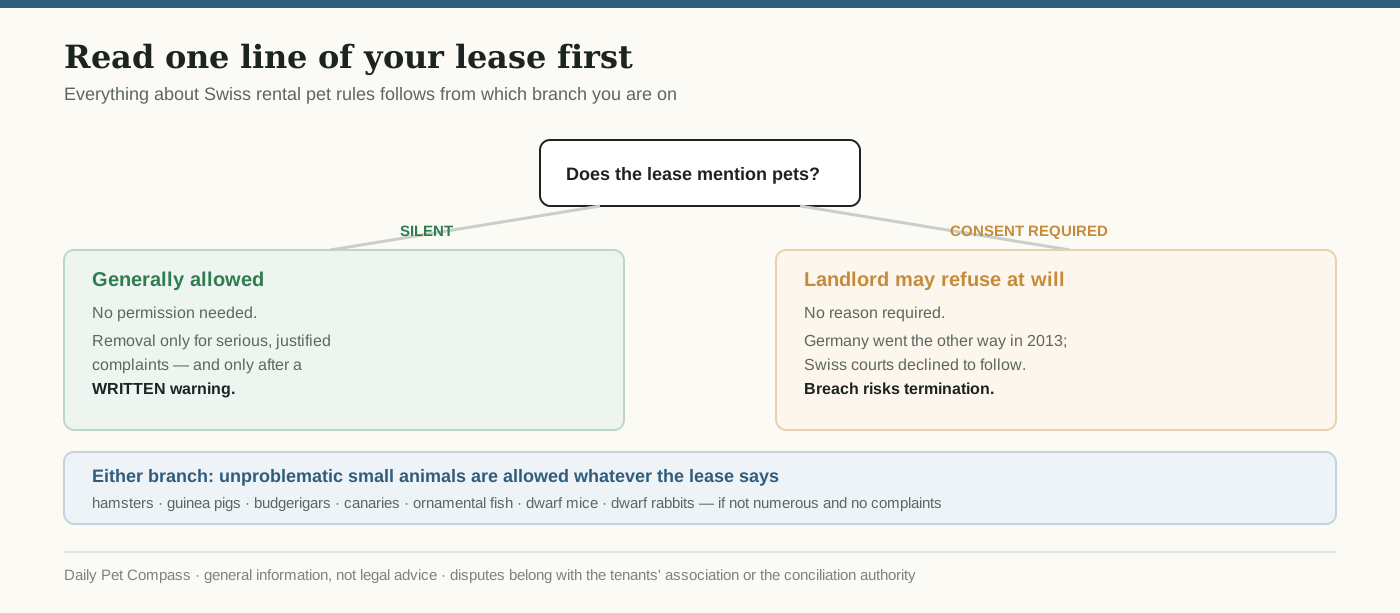
The Swiss position turns on one question, and it is not about your animal at all. It is about what your lease says — and the two possible answers lead to almost opposite outcomes.
If your lease says nothing about animals
Then you may generally keep a pet. No permission needed.
The landlord can only demand that the animal go if it actually causes serious and justified complaints, and even then they must first warn you in writing before requiring removal. A dog that exists is not a complaint. A dog that barks for six hours a day is.
Two limits sit on top of this. Species with high disturbance or danger potential — parrots and venomous snakes are the examples usually given — need agreement regardless. And "a pet" does not mean nine of them; large numbers are treated differently.
Require consent, and the answer flips hard
Most Swiss leases are written this way, and here the answer flips hard.
If your contract makes pet-keeping conditional on the landlord's agreement, the landlord may refuse at will and does not have to give a reason. Not an unreasonable reason, not a weak reason — no reason. The Federal Supreme Court settled this in a decision back in February 1994.
Which brings us to why the expat advice is wrong. In 2013 the German Federal Court of Justice held that a landlord there may not ban pets without an objective reason, and that ruling travelled. Swiss courts were watching and declined to follow: in June 2015 the Zurich Cantonal High Court held that refusal lies within the landlord's free discretion. Zurich does not bind the other cantons, but its practice carries substantial weight across the country.
So the German rule is real, and it stops at the border.
The exception almost nobody uses
Here is the part worth knowing before you sign anything, because it survives even an explicit ban in the lease.
Unproblematic small animals are permitted whatever the contract says. The list that gets named: hamsters, guinea pigs, budgerigars, canaries, ornamental fish, dwarf mice, dwarf rabbits. The conditions are that you do not keep them in large numbers and they give nobody cause for complaint.
A lease that says "no pets" therefore does not mean no pets. It means no dog without asking.
Two practical footnotes. If an aquarium needs any work touching the building fabric, get written consent. And if you keep fish at all, check that your private liability insurance would cover water damage, because a failed tank in a Swiss apartment building is an expensive way to learn that it does not.
Cats sit on the line, and the reason is uncomfortable
The developing view treats a cat as an unproblematic small animal provided it does not leave the flat — which, if your lease bans pets, is a genuinely useful thing to know.
But the tenants' association raises the obvious objection itself, and it deserves repeating rather than burying: whether permanently confining a cat indoors amounts to species-appropriate keeping is an open question. The legal category and the welfare answer are not the same thing.
If you take that route, take the welfare side seriously — vertical space, window access, real daily play, enrichment that changes. An indoor cat can live well. An indoor cat treated as a legal workaround usually does not.
Did the landlord already know?
If the landlord knew you had the dog and said nothing, agreement is presumed to have been given tacitly, whatever the lease states. Three years of the landlord greeting your dog in the stairwell is not nothing.
The reverse trap is worth naming too: there is no equal-treatment principle in Swiss tenancy law. You cannot argue that the neighbours have a cat, so you should be allowed one. Swiss tenancy law contains no such requirement. It may still work as persuasion — landlords dislike bad feeling in a building — but it is not a right.
The move that actually works
Landlords often refuse because nothing about the arrangement is defined, and a vague yes feels riskier than a simple no.
There is a ready-made fix for exactly that: a model contract addendum for pet keeping, developed by the institute for interdisciplinary research into human–animal relationships and published for download by the tenants' association. It sets out rights and obligations on both sides and accounts for the animal's needs as well as the landlord's.
Proposing a specific written addendum converts "may I have a dog" into "here is how this would be governed." That is a much easier thing for a hesitant landlord to say yes to.
Exotic and wild species are a separate matter entirely: many require authorisation from the cantonal veterinary office and a great number may not be kept or imported at all on species-protection grounds.
None of this is legal advice, and a real dispute belongs with the tenants' association, a lawyer, or the conciliation authority for your commune. But before you ask anyone anything, read your own lease and find out which of the two cases you are in. Everything follows from that one line.