Walk into any pet store and you're looking at a wall of answers to questions your animal never asked. Some of it is genuinely useful. Most of it is a product invented to sit in the gap between "my pet is fine" and "but what if I'm missing something?"
That gap is where money goes to die.
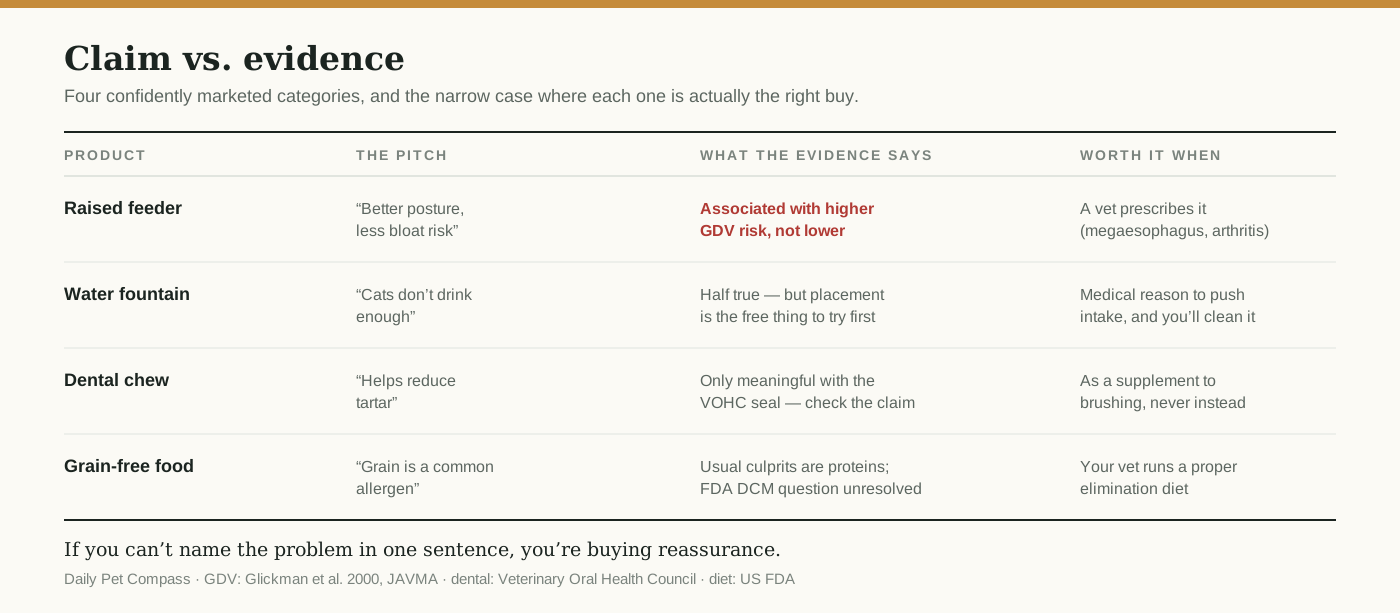
Here's the filter worth applying to four of the most confidently marketed categories in the shop. Not "never buy these" — for each one there's a real case where it's the right call. But the default answer is usually no, and the marketing never tells you that.
The raised bowl that may be doing the opposite of what it promises
Elevated feeders get sold on posture and digestion, and for large breeds the pitch usually includes something about reducing the risk of bloat — gastric dilatation-volvulus, the twisted-stomach emergency that kills big dogs fast.
The research points the other way. A prospective cohort study out of Purdue, published in JAVMA in 2000, looked at non-dietary risk factors for GDV in large and giant breeds and found that several measures intended to prevent it — raising the food bowl, moistening dry food, restricting water around meals — were associated with significantly increased risk. Roughly 20% of GDV cases in large breeds and 52% in giant breeds were attributed to feeding from a raised bowl.
That's an association from observational data, not proof of cause, and it doesn't mean every raised bowl is dangerous. But it does mean the single most common reason people buy them is, at best, unsupported and quite possibly backwards.
Where a raised bowl genuinely earns its place: a dog with diagnosed megaesophagus, arthritis, or a neck or mobility problem where a vet has specifically recommended feeding height. That's a prescription, not a lifestyle purchase.
If your large-breed dog is healthy, a bowl on the floor is fine. Ask your vet about actual GDV risk factors instead — they'll talk about meal size, eating speed, and whether prophylactic gastropexy makes sense for your breed. None of that is solved by furniture.
Water fountains
The pitch: cats don't drink enough, and moving water fixes it.
The first half is sometimes true. Cats evolved getting most of their water from prey, and a cat eating only dry food is working from a real deficit. The second half is where it falls apart — plenty of cats ignore fountains entirely, and every fountain is a pump, a filter, and a set of crevices that need cleaning on a schedule you will resent by week three.
Before you buy one, try the free version. Move the water away from the food bowl. Add a second bowl somewhere else in the flat — different room, different height, away from the litter box and away from the washing machine. Use a wide, shallow dish so nothing brushes the whiskers. (The "whisker fatigue" idea gets stated with more confidence than the evidence supports, but a wide bowl costs nothing to try.)
If your cat drinks more after that, you solved it for the price of a dish you already own.
Buy the fountain when there's a medical reason to push intake — kidney disease, urinary issues, a vet asking you to increase water — and when you've honestly assessed whether you'll clean it weekly. A neglected fountain is worse than a clean bowl.
Dental chews are not brushing, and the seal matters more than the slogan
This is the category where marketing language does the most work. "Helps reduce tartar" is a phrase, not a standard, and it appears on products that do approximately nothing.
There is an actual standard: the Veterinary Oral Health Council seal. VOHC awards it to products that have submitted trial data showing they meaningfully reduce plaque or tartar, and it publishes the full accepted list for dogs and cats.
Two things make that list more useful than the seal alone.
First, plenty of mainstream supermarket brands are on it. This isn't an exotic boutique club, so there's no excuse for buying an unaccepted chew on the assumption that the good stuff is unaffordable.
Second, and almost nobody notices this: the seal specifies what it's for. Each accepted product is listed against a claim of "Plaque," "Tartar," or both. Those aren't the same problem — plaque is the soft film that drives disease, tartar is the hardened deposit. A product accepted for tartar only hasn't been shown to do the other job. Check the claim, not just the logo.
Even with the seal, chews supplement brushing rather than replacing it. Daily brushing with a pet-safe toothpaste is the thing that works, and no chew moves you off that. The VOHC list even includes plain soft-bristle toothbrushes, which tells you where the council thinks the value sits.
Grain-free, for a dog who isn't allergic to grain
Grain-free went mainstream on the strength of a folk theory — that grain is a common allergen for dogs. In practice, when dogs do have food allergies, the usual culprits are proteins: beef, dairy, chicken. Grain allergy exists but is not the epidemic the shelf space implies.
Then it got complicated. In July 2018 the FDA began investigating reports of dilated cardiomyopathy — an enlarged, weakened heart — in dogs eating diets heavy in peas, lentils, other legume seeds and potatoes, many marketed as grain-free. By late 2022 it had received well over a thousand reports.
Be precise about where that landed, because both camps overstate it. The FDA has not established a causal link. It also hasn't cleared the diets: it stopped publishing routine updates pending new science, and the mechanism remains unexplained. "We looked into a possible heart problem, couldn't explain it, and stopped issuing bulletins" is not the same as "case closed" — and it's a strange foundation for a purchase whose original justification was a myth about grain.
If you think your dog has a food allergy — recurrent ear infections, itchy skin, chronic GI upset — that's a veterinary diagnostic process, usually a properly run elimination diet. It isn't a shelf you switch to.
What I'd spend the money on instead
A dedicated measuring scoop and, better, a cheap kitchen scale. Portion drift is real and invisible; "a cup" varies wildly depending on who's pouring and what mood they're in, and weight creeps on quietly over a year. A scale costs less than one bag of boutique food and it's the only item on this page that reliably changes an outcome.
The pattern across all four categories is the same: the product is sold as insurance against a vague fear, the fear was manufactured alongside the product, and the actual fix is either free, behavioural, or a conversation with your vet.
Buy the thing that solves a problem you can describe in one sentence. If you can't name the problem, you're buying reassurance — and it doesn't work. The worry comes home with you and the box goes in the cupboard.