Ask three dog owners here whether their animal is insured and you will get three answers that are not about the same thing.
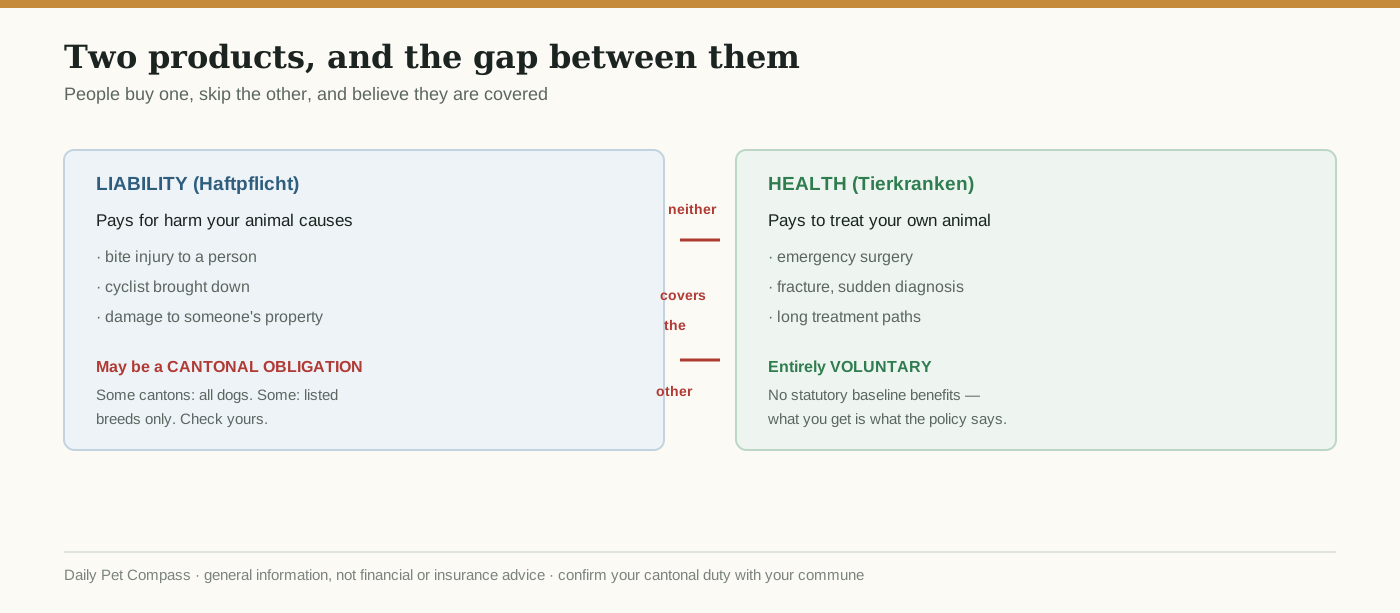
There are two entirely separate products, they solve unrelated problems, and one of them may be legally required where you live while the other is purely optional. People buy the optional one, skip the possibly-mandatory one, and believe they are covered.
Liability cover is the one that might not be your choice
Third-party liability insurance — Haftpflicht — pays when your animal causes harm to someone else. The dog that bolts into a cyclist's front wheel. The dog that bites. The dog that runs into a road and causes a car to swerve.
In Switzerland this is not merely prudent. A number of cantons require dog owners to hold liability cover, and the duty is cantonal rather than federal, which means it differs depending on where you live. Some cantons impose it on all dog owners; some impose it only for listed breeds; some set a minimum sum you must be covered for.
That is as specific as this article will get, on purpose. The rules vary, they change, and getting them from a blog is exactly the wrong approach for a legal obligation. What matters is that you find out whether you are currently in breach.
How to check, in about ten minutes:
- Look at your canton's dog legislation or the cantonal veterinary office pages — the liability requirement usually sits alongside registration and dog-tax rules rather than under "insurance."
- Ask your commune when you register the dog or pay the dog tax. They deal with this constantly and will tell you plainly.
- Then read your own private liability policy. Many household private-liability policies already include pets, but not all do, and not always at a sum that meets a cantonal minimum. The relevant question for your insurer is not "am I covered" but "what sum am I covered for, and does it include damage caused by my dog."
That last step catches people who genuinely believed they were insured, because in a sense they were — just not for this, or not for enough.
The other product is a spreadsheet question
Pet health insurance covers your animal's own treatment. It is entirely voluntary. Unlike the health insurance you carry yourself, nothing obliges you to have it and no baseline benefits are guaranteed by law, so what you get depends completely on the policy.
Which makes it an arithmetic problem rather than a moral one. You are not a bad owner for declining it, and you are not a prudent one for buying it without reading the terms.
Six clauses that decide whether a policy is worth anything
Before comparing premiums, compare these. Two policies at the same monthly price can differ enormously here.
- Waiting period. Cover typically does not start on day one. If your animal develops something during the waiting window, that is on you — and possibly permanently, via the next clause.
- Pre-existing conditions. Almost universally excluded. This is the single reason insuring young and healthy is a different transaction from insuring an animal that already has a history.
- Entry age limit. Many insurers will not take on an older animal at all, and premiums generally climb as the animal ages — which is precisely when you start to claim.
- Annual cap. The maximum the policy pays in a year. A cap set below the cost of the surgery you are insuring against defeats the purpose.
- Deductible and co-pay. Usually you carry a fixed amount plus a percentage of what remains. Both matter, and the percentage matters more than people expect on a large bill.
- Breed and hereditary exclusions. If you own a breed with well-documented predispositions, read this clause first, because it may exclude the exact thing you are worried about.
What insurance is actually for
Here is the position, and it is not the one the marketing takes: pet health insurance is not a discount scheme for routine care.
Vaccinations, annual checks, flea and worm treatment, dental cleaning — these are predictable, recurring costs. Predictable costs are a budgeting problem, and running them through an insurer means paying an administrative margin for the privilege of smoothing a bill you could have anticipated.
What insurance is genuinely for is the event you cannot absorb: the emergency surgery, the fracture, the sudden diagnosis with a long treatment path. Low probability, high cost, arrives without warning. That is what the product is built for and where it earns its premium.
So the honest test is not "does it pay for itself on average." Over a large population it cannot — insurers price it so it does not. The test is: if a large bill landed next month, could you pay it without the money changing the medical decision?
If the answer is yes, self-insuring is defensible — provided you actually do it. A standing order into a dedicated account, started when the animal is young, is a real alternative and not a rhetorical one. If the answer is no, then the value of a policy is not the expected return. It is that you never have to weigh your animal's treatment against your rent.
Where the two products stop overlapping
One last thing worth being clear about, because it catches people at the worst moment: liability cover does not pay to treat your own animal, and health cover does not pay for the damage your animal does to someone else.
If your dog is hit by a car, whether anything pays — and which policy — depends on fault, on your cover, and on the driver's. That is a conversation to have with your insurer while everyone is calm, not from a clinic waiting room.
None of this is financial or insurance advice, and no article can tell you what your policy says. Read your own terms, confirm your cantonal obligation with your commune, and treat any figure you find online — including the ones you will be quoted by a comparison site — as a starting point for a question rather than an answer.